
Vijay Prasad
The collapse of Rojava was not just the failure of a local revolt. It was the defeat of a political bet: that armed self-defense could count on the support of the United States.
THE SUN SETS ON THE KURDISH REBELLION WITH THE AGREEMENT THAT ENDS THE SYRIAN KURDISH ENCLAVE
The agreement that ended the Syrian Kurdish enclave was presented by its signatories as a pragmatic solution. But, in reality, the agreement represents a major political defeat for the Syrian Kurdish political formations. Without a doubt, the rapid advance of Syrian armed gangs loyal to “president”Ahmad al-Sharaa (former head of Al Qaeda) broke the resistance of the Syrian Democratic Forces (SDF), the majority Kurdish group, but this advance can only be understood by the full support given by the US to the Syrian extremist regime against the SDF.
The SDF (which always supported the US) was outnumbered and did not have air support, from which they had benefited in their war against the Islamic State and against the democratic government of Assad. Mazlum Abdi of the SDF signed the effective surrender on behalf of his party and his army. US Ambassador Tom Barrack’s tweet, despite its hyperbole, suggested the end of the Syrian Kurdish experiment called Rojava (a Kurdish word meaning “where the sun sets”, or the western part of the Kurdish lands).
The agreement formalized what months of military pressure had already made clear. Syrian state institutions returned to the northeast not as partners, but as authorities interested in a strong central state loyal to al-Sharaa. Over the past year, border crossings that had been in the hands of various groups returned to central government control and oil revenues began to be collected for Damascus.
The Syrian Democratic Forces, one of al-Sharaa’s last remaining independent military challenges following the defeat of the state-run Syrian Arab Army, agreed to be subordinated to the army’s central command, but did not want its units dismantled; In other words, the SDF wanted to maintain its own structures within the Syrian armed forces. This was the agreement that Abdi and other Kurdish leaders, such as Ilham Ahmed (former co-chair of the SDF), favored, but were overtaken by sections of the Syrian Kurdish leadership who did not want to lose the autonomy of the Kurdish enclave. Now Kurdish political offices have begun to close, flags are being removed and the language of autonomy has been erased from official documents.
The jihadist Al-Sharaa came to the ‘presidency’ of Syria thanks to his politicization in the Syrian fronts of Al Qaeda. Although he has ditched his turban for a suit, there are signs that his own followers are comfortable with the ideology and ties to Al Qaeda and the Islamic State, and welcome an alliance with both the US and Israel. In the days leading up to this ceasefire and agreement, SDF officials reported that the Syrian military focused its attention on prisons housing Islamic State fighters captured by the SDF; indeed, heavy fighting was reported near Shaddadi prison (Hasaka) and al-Aqtan prison (Raqqa).
According to the SDF, these attacks constituted a “very dangerous development”as they suggested that government forces wanted to release Islamic State fighters from prisons and put them back on the battlefield against groups like the SDF. Now the State has control of these prisons and can do whatever it wants with these prisoners.
The dawn of Rojava
In 2012, the democratic government of Bashar al-Assad withdrew its troops from the northeast following an agreement with the Kurds and in order to defend the southwest from a series of rebellions. This withdrawal represented an opportunity for the Syrian Kurds, who had been fighting for decades for an independent Kurdistan or for autonomy within Syria.
Democratic Union Party (PYD) leader Salih Muslim told me in 2013 that Kurdish political and military forces filled a void. “We organized our society so that chaos would not prevail.”The PYD’s Muslim raised three points: Syria must remain united, Syria must belong to all who live in it, and Syria must be decentralized. The Government of Damascus accepted these three points and a tacit agreement was reached between the Syrian Kurdish political forces, other minorities in Syria and the al-Assad Government. This was the opportunity that allowed the birth of Rojava.
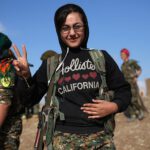
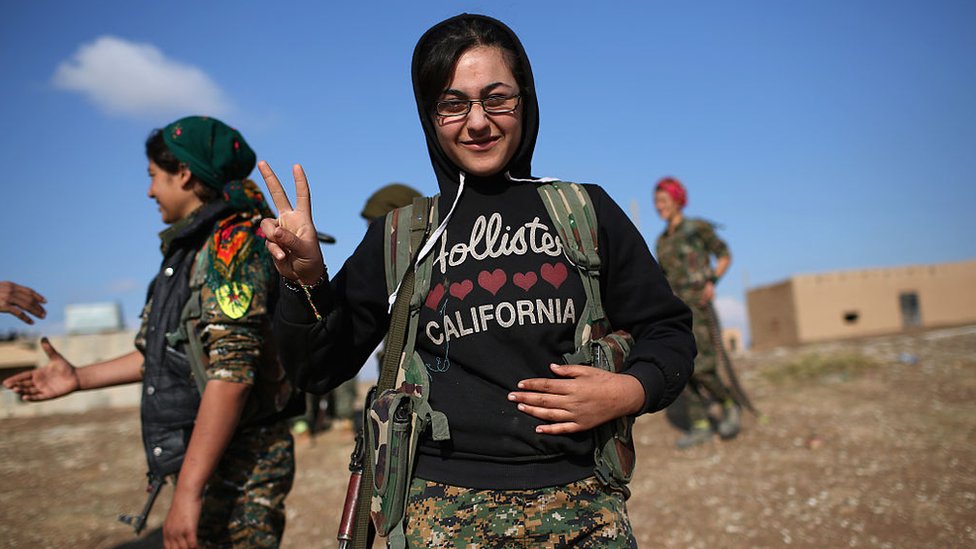
In the decade since 2012, the Rojava enclave suffered serious attacks by the Islamic State (in 2014-2015) and the Turkish armed forces (in 2018), as well as continued attacks by several smaller groups. In this decade, the SDF army, the People’s Defense Units (YPG), the Kurdish peshmerga (from Iraq) and the armed forces of the Kurdish Workers’ Party (PKK from Turkey) defended this enclave, especially from the advance of the Islamic State. When the Islamic State took over Sinjar and began ethnically cleansing the area of Yazidis in August 2014, it was the YPG and its allies who began a long siege of the area that they only managed to win in November 2015, at great cost.
American air support began to self-interestedly assist the YPG and SDF in their attempt to defeat the Islamic State and exist as an enclave independent of Damascus. Neither Salih Muslim nor other leaders of the Syrian Kurdish groups placed all their faith in the US, although the balance of forces set in motion an alliance that would inevitably lead to betrayal.
Salih Muslim and Mazlum Abdi’s statements that silence over the 2018 Turkish invasion of Afrin would “cost Syria its unity”or that the YPG was the only “barrier against the Turkish occupation”did not help much. Assad was not going to anger the Turkish government at that time (in fact, it was during this period that Russian President Vladimir Putin and Turkish President Recep Tayyip Erdogan signed an agreement to demilitarize Idlib and allow the heirs of Al Qaeda, including al-Sharaa’s Hay’at Tahrir al’Sham or HTS, to strengthen their power in peace and hope for a change of fortune).
Perhaps if Assad had been a better chess player, he would have provoked Turkey by defending the Syrian Kurds, thus preventing a deal and forcing his Russian allies to provide air support as the Syrian Arab Army entered Idlib to fight what remained of the HTS and its allies. But Assad began to allow the Russians to do his strategic thinking and therefore gave up a point of strength in the hope that the Turkish Government would cease its attempt to overthrow his Government.
Erdogan refused to see the Syrian Kurdish rebellion as anything other than an extension of the Turkish PKK fight. In 2020, he told his party cadres at a meeting: “Turkey will never allow the establishment of a terrorist state right next to its borders. We will do whatever is necessary and drain this swamp of terrorism.”Both Assad and the Syrian Kurds had to be clear that they were not going to receive any support from Turkey and that there was going to be no end to the destabilization attempts by the Turkish NATO partner, the US.
Over the past five years, Erdogan pressured the PKK’s political leaders to withdraw their rebellion and effectively capitulate. In 2025, from his Turkish cell, PKK leader Abdullah Öcalan announced “the end of the method of armed struggle.”The Syrian Kurdish project, linked to the PKK, lost its broad strategic depth. Turkish pressure on the Syrian Kurds to end their “armed autonomy”project, as Turkish officials put it, increased. Turkish military pressure continued with little international condemnation or even consideration and a decline in Kurdish legitimacy.
Israel’s mysterious role in this entire fiasco has not yet been adequately described.
The fall of Assad
Under the full weight of Israeli and American airstrikes, the extremist forces of Hay’at Tahrir al’Sham, led by Ahmad al-Sharaa, stormed Damascus. This victory marked a decisive break for the Syrian Kurds. Al-Sharaa, the new ‘president’, claimed that his regime would take back the northern lands (but said nothing about the Israeli occupation of the Golan Heights or the hundreds of square kilometers of the UN buffer zone that Israel seized after al-Sharaa took Damascus).
The statements from Damascus sent a warning to the Kurds, although the Kurdish leaders hoped, against all logic, that the US would protect them (in December 2024, Abdi said that the Syrian Kurds were in “continuous communication with our American friends(!), who support our efforts to stop the escalation and guarantee the rights of all Syrian components, including the rights of the Kurds within the framework of a unified state”).
The US began to withdraw and the Syrian Kurds began to express their hopelessness. An SDF official told me that her forces had fought ISIS and had suffered huge casualties, but were now, in her own words, “nothing at all.”The forces of the new Syrian regime flooded into the north. “Syria does not need forcibly imposed experiments,”al-Sharaa said. Rojava was in their sights. It didn’t take long to finish the job. “We are determined to protect the achievements of the revolution,”Abdi said, but this seems more like wishful thinking.
Syria’s example has sent a cold breeze across the border to the autonomous Kurdish region of northern Iraq. Iraqi leader Muqtada al-Sadr posted a message on X with a warning that what happened in Syria “should not be taken lightly.””The danger is imminent,”he wrote, “and terrorism is supported by global arrogance.”With the Turkish PKK’s change of strategy and the defeat of the Syrian Kurds, any faith in Irbil (Iraq) that the Kurdish autonomous region will last forever will now fade. Al-Sadr suggested unity in the face of external aggression. It’s a suggestion that would be difficult to reject in these times.
The collapse of Rojava was not just the failure of a local revolt that could not be sustained. It was the defeat of a political bet: that decentralization and armed self-defense could count on the support of the United States. The language of democracy and dignity may have attracted the occasional American diplomat, but it meant nothing in Washington. “We built Rojava on a swamp,”a Syrian Kurdish official told me a few hours after the agreement.
source:globetrotter.media/lahaine.org


+ There are no comments
Add yours